The Los Alamos Primer - Part 2
Simplest Estimate of Minimum Size of Bomb
In Part 1 I covered the first few sections of the Los Alamos Primer: energy release, cross-sections, and why ordinary uranium can't sustain a chain reaction. This post picks up where we left off - figuring out how big a lump of fissile material needs to be before it goes critical.
We will model neutron transport as a diffusion process and solve for the geometry where production exactly balances leakage. The original text skips a lot of steps and rushes through this section, so I'll try to fill in the gaps.
Please note that this is what the Primer calls the "simple" diffusion theory. We won't get quite the "proper" results from it. The Primer says as much:
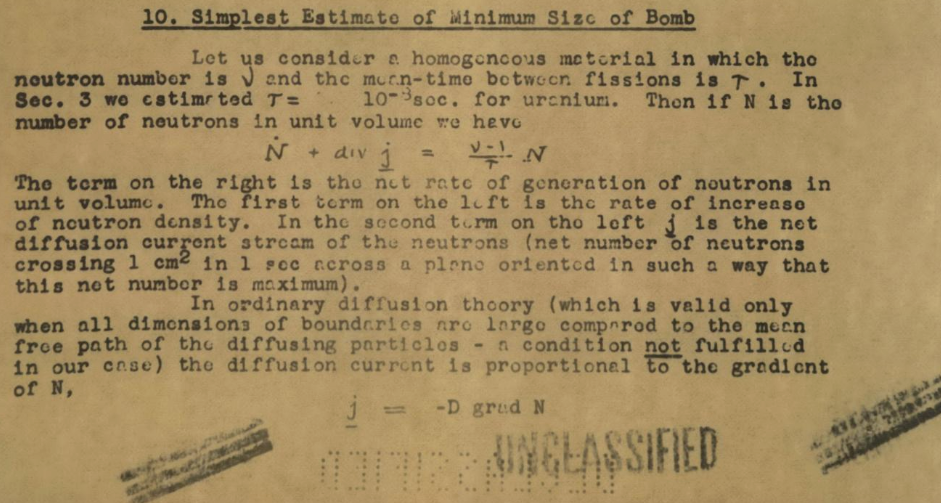
Specifically, this bit:
In ordinary diffusion theory (which is valid only when all dimensions of boundaries are large compared to the mean free path of the diffusing particles - a condition not fulfilled in our case)
Still, I think going through this is valuable:
- we get an overestimated result but within the right ballpark
- we can attempt to correct some of the assumptions we make for a better result
- the general "diffusion process" modelling is very powerful
The Diffusion Equation
We start with neutron density
-
Production: Each fission produces
-
Diffusion: Neutrons scatter around and tend to flow from high-density regions to low-density regions. The current (flux of neutrons) is proportional to the gradient:
Aside: Wait, what is a "Mean Free Path" actually?
If you're wondering why the Primer keeps swapping between
and (cross-sections), here is the quick and dirty version. Imagine running blindfolded through a forest.
is the density of trees (trees per ). is the "cross-section" of a tree trunk - literally how "fat" the target is (in ). If you multiply them, you get
(often called the Macroscopic Cross-section, ). The units are . This represents the probability of smacking into a tree per meter you run. If you have a probability of hitting something per meter, the average distance you travel before hitting it is just the reciprocal:
That's it. It's just a probability inversion. High density (
) or fat targets ( ) mean a short path ( ). In our case, we actually have two different mean free paths because the trees are weird:
: How far you run before you hit a tree that explodes (fission). : How far you run before you hit a tree and bounce off (scattering/transport).
Combining these gives the diffusion equation:
where
Separation of Variables
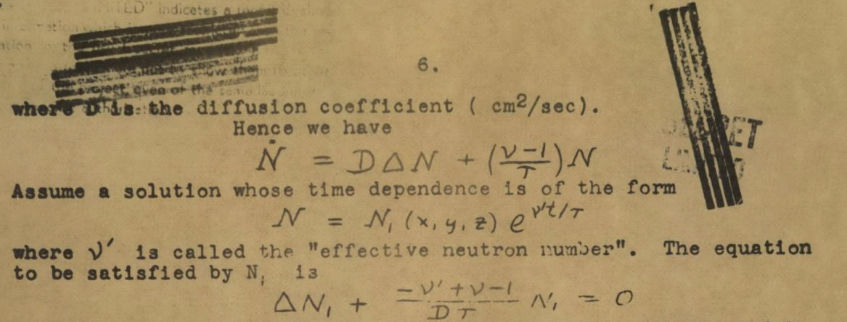
We want to find steady-state behaviour, so assume the solution separates into spatial and temporal parts:
Here
Taking the time derivative:
And substituting back into the diffusion equation:
The exponential factor cancels (since the Laplacian only acts on spatial coordinates), leaving:
Rearranging:
If we define
Note that
This is an eigenvalue problem. The geometry and boundary conditions determine
Solving for a Sphere
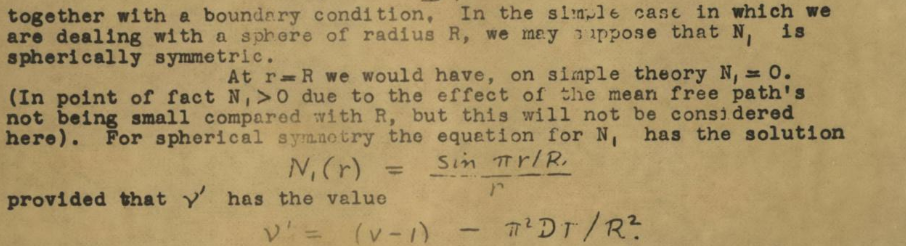
A sphere is a natural starting point.
For a sphere of radius
So we need to solve:
There is a standard trick here. Substitute
This is just simple harmonic motion. The general solution is:
So:
Boundary Conditions
This is where we plug in our assumptions.
At the origin (
At the surface (
For non-trivial solutions,
The solution is:
The Critical Radius
Now we connect
With
The critical radius
This is the key result. Now, let's substitute our definitions for
The velocity
And the critical radius formula becomes:
This makes physical sense: the critical size scales with the geometric mean of the transport and fission mean free paths. Longer mean free paths mean neutrons travel further before interacting, so you need a bigger sphere to keep them contained. More neutrons per fission (
What About Other Shapes?
The sphere is optimal - it has the smallest surface-area-to-volume ratio, minimising neutron leakage. But what if your fissile material is cast into a different shape?
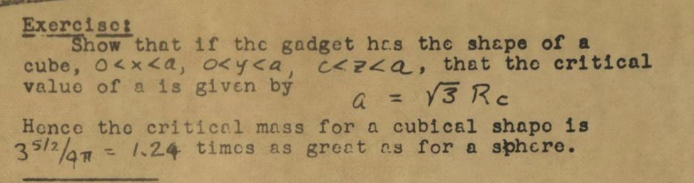
The Cube
We are presented with the following exercise:
Show that if the gadget has the shape of a cube,
that the critical value of is given by .
Let's consider a cube of side length
Except now we use good old Cartesian coordinates. We also assume a separable solution:
Substituting and dividing by
Here is the key insight: each term depends on a different variable, but they sum to a constant. This is only possible if each term is individually constant[2]:
with
Applying boundary conditions
So:
Comparing Sphere and Cube
At criticality, both systems have the same
A critical cube has side length about 1.73 times the critical radius of a sphere made from the same material. To put that in terms of material needed: the critical cube has volume
Physical Reality
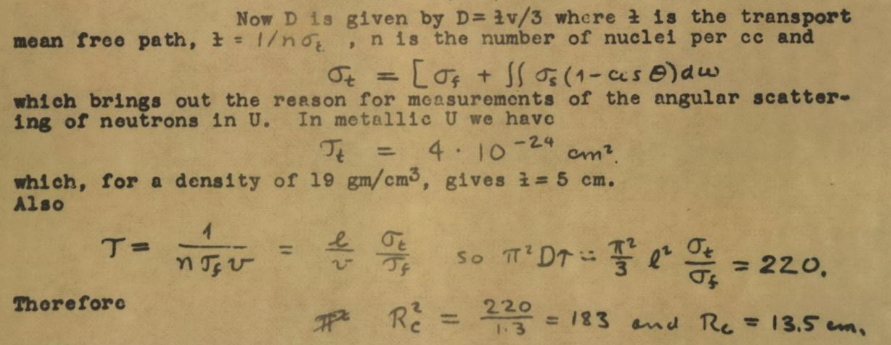
Now to tie this all together. The Primer uses the following values for U-235:
Plugging into our formula:
This is extremely close to the Primer's stated result of
A Note on the Numbers
You might notice we got
The discrepancy arises because we approximated
Aside: The "Persistence of Velocity" Adjustment
I wanted to cover this since it shows up suddenly in that final calculation
Specifically, that
The
-
Forward Scatter (
- Weight:
- The math says: "This collision didn't happen." The neutron is treated as if it passed right through.
-
Sideways Scatter (
- Weight:
- This counts as a standard, "ideal" collision.
-
Backward Scatter (
- Weight:
- This counts double. Not only did it stop the forward flow, it reversed it.
So
(Note that
Using
So is 200 kg the actual answer? Not quite.
Our Accuracy
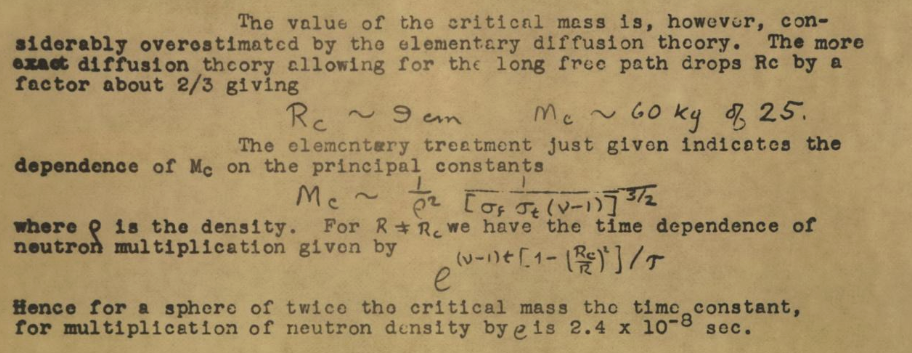
The math checks out, but the physics is still an overestimate. The elementary diffusion theory gives us
So where did we go wrong? It seems the main culprit is our boundary condition. We set
However, real neutron transport is apparently a bit messier. From what I understand of the "proper" transport theory (which gets complicated very quickly), the neutron density doesn't actually hit zero until a short distance outside the physical sphere. This is known as the "linear extrapolation distance" - essentially, the vacuum outside the sphere reflects the lack of incoming neutrons in a way that makes the sphere "feel" slightly larger than it is.
The standard correction involves pretending the sphere has a radius of
With the corrected radius of
TBC
Next time I'll cover the tamper and revisit this diffusion theory.
- ← Previous
Verifying the fraction